
TL;DR: The Top Recommendations for Quantum Computing for AI
Let’s face it: “quantum computing for AI” sounds like a phrase straight out of a sci-fi blockbuster, not your Monday morning stand-up. But here we are. If you’re tired of hearing about its theoretical potential and want to actually *do something* with it—or at least understand who’s building the playgrounds—you’re in the right place. We’ve dug through the quantum entanglement (and the marketing hype) to bring you the top three Quantum-as-a-Service (QaaS) providers currently leading the charge for AI applications: IBM Quantum Experience, Amazon Braket, and Microsoft Azure Quantum. Each offers a unique blend of hardware, software, and developer support to start (or continue) your journey into quantum AI without needing to build your own quantum lab in the garage.
Quick Navigation
Navigating the Quantum Frontier for AI: Our Top 3 Picks for 2024
Alright, confession time: a few years ago, if you’d asked me about the “best quantum computing for AI,” I probably would have mumbled something about “future potential” and then swiftly changed the subject to the latest meme stock. The truth is, the intersection of quantum computing and artificial intelligence has long felt like a distant dream, more academic paper than practical application. The barrier to entry? Astronomical. You needed a PhD, access to multi-million dollar hardware, and a penchant for existential dread contemplating superposition.
But things are changing. Rapidly. The advent of Quantum-as-a-Service (QaaS) platforms means you don’t need a cleanroom or a direct line to Schrödinger’s cat to experiment with quantum algorithms. These services democratize access, letting you tap into real quantum hardware via the cloud. The question now isn’t *if* quantum computing will impact AI, but *how* and *when* you (or your competitors) will start using it. Many still wonder: “Can quantum computers truly solve today’s AI problems, or is it just hype?” The answer, as always, is nuanced. While a true quantum advantage for general AI is still on the horizon, specific quantum machine learning (QML) algorithms are showing promise in areas like optimization, pattern recognition, and complex data analysis, offering tools that could augment or even revolutionize classical AI approaches. The key is knowing which provider offers the most accessible and effective tools for current and near-future AI endeavors.
We’ve done the heavy lifting, sifting through the qubits and the quantum gates, to identify the top three QaaS providers that are making genuine strides in supporting AI development. Forget the corporate jargon about “leveraging synergies”—we’re talking about tools you can actually use to build, test, and run quantum-inspired or quantum-native AI algorithms. This isn’t just about accessing raw computing power; it’s about the entire ecosystem: development kits, communities, learning resources, and importantly, cost structures that make experimentation feasible. So, if you’re ready to dip your toes into the quantum pool without getting completely soaked, let’s dive into our top recommendations for the best quantum computing for AI.
1. IBM Quantum Experience for AI Development
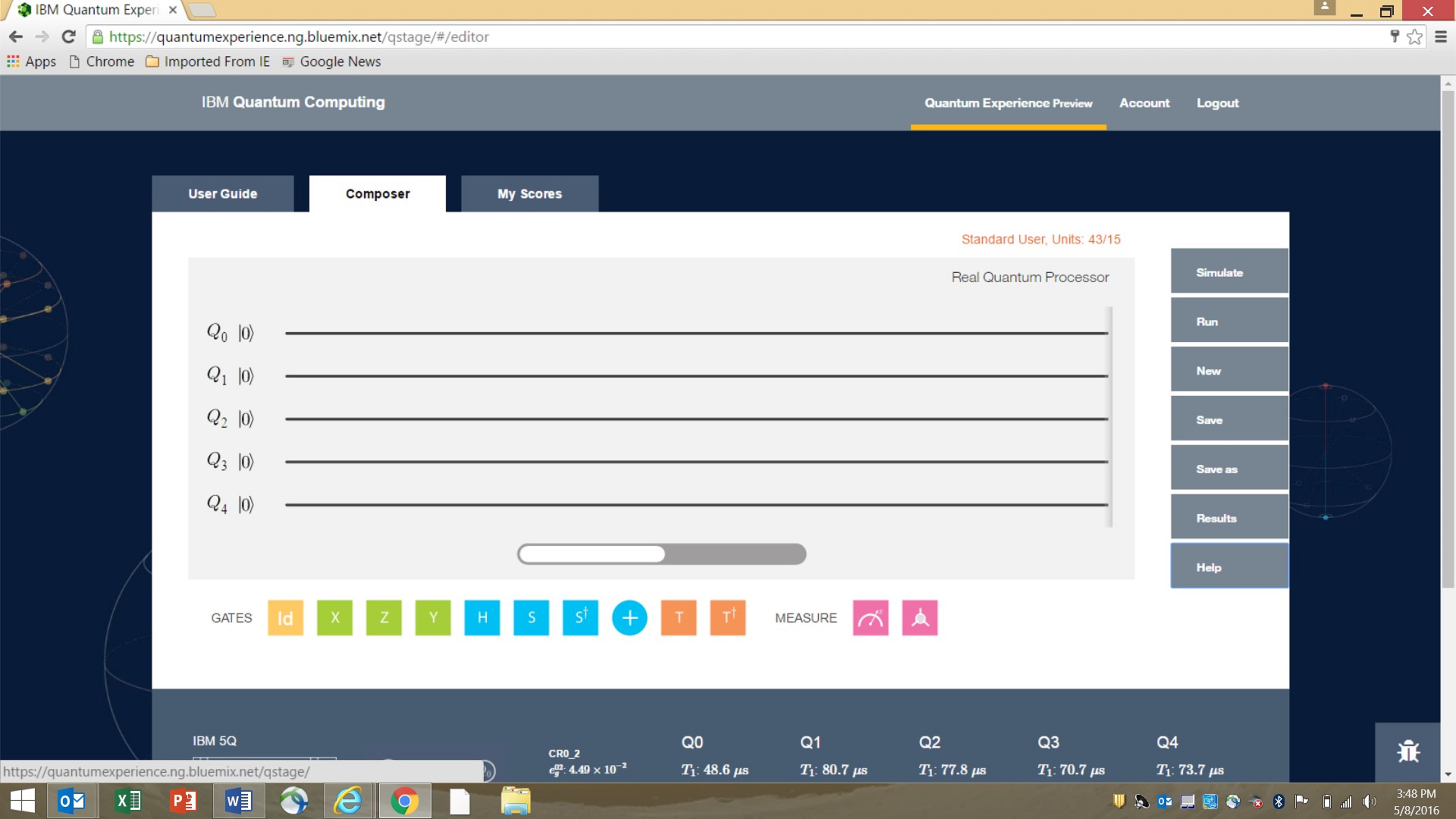
IBM has been a titan in the quantum computing space, and their Quantum Experience platform is arguably the most mature and accessible QaaS offering for anyone looking to experiment with quantum computing, especially for AI applications. It’s built around their open-source Qiskit framework, which acts as a fantastic bridge between classical Python development and the esoteric world of quantum circuits. For AI practitioners, this means you can often integrate quantum components into your existing Python-based machine learning workflows with a relatively manageable learning curve.
What makes IBM Quantum particularly compelling for AI is its robust ecosystem. Beyond direct hardware access, you get a wealth of tutorials, community support, and a growing library of Qiskit Machine Learning algorithms designed for tasks like classification, regression, and generative modeling. They’re constantly pushing the boundaries of what’s possible, from larger qubit counts on their superconducting processors to enhanced error mitigation techniques. If you’re a developer who appreciates a strong community, ample learning resources, and a comprehensive SDK that plays nice with classical tooling, IBM Quantum is a solid bet for exploring the best quantum computing for AI.
Many of the “content gaps” we often see around quantum for AI—namely, “how do I actually *start* using this?” or “what specific AI problems can it address today?”—are directly tackled by IBM’s approach. They provide clear examples for quantum optimization algorithms and quantum neural networks, allowing AI researchers to explore how these approaches might complement or outperform traditional methods in specific problem domains. Their commitment to open-source via Qiskit has fostered a vibrant developer community, making it easier for new users to find answers and collaborate. This accessibility makes it a prime candidate for those seeking practical applications of quantum computing in artificial intelligence.
Key Benefits for Quantum AI
- Qiskit Framework: An extensive, open-source Python SDK for quantum programming, making it highly familiar for AI developers. It includes modules specifically for machine learning, optimization, and chemistry.
- Hardware Access: Direct cloud access to a range of IBM’s superconducting quantum processors (Transmon qubits) with varying qubit counts, from smaller test systems to more powerful devices.
- Vibrant Community & Learning: One of the largest and most active quantum computing communities, supported by extensive documentation, tutorials, courses, and a thriving forum. This is crucial for navigating the complexities of quantum AI.
- Hybrid Workflows: Strong support for integrating quantum circuits into classical AI pipelines, allowing for hybrid quantum-classical algorithms that can run partially on quantum hardware and partially on traditional CPUs/GPUs.
- Research Focus: IBM is at the forefront of quantum research, offering early access to new advancements and techniques relevant to quantum machine learning.
Pricing for IBM Quantum Computing for AI
IBM offers a multi-tiered pricing model. A generous free tier provides access to simulators and smaller quantum processors, perfect for learning and prototyping. Paid plans scale based on processing time (in “Qiskit Runtime credits”) for more powerful hardware and longer execution times, with enterprise-level agreements available for larger organizations. This flexibility makes it accessible for individual researchers and startups alike, ensuring that experimentation with quantum AI doesn’t require an initial venture capital round.
| Pros | Cons |
|---|---|
| The Qiskit ecosystem is a huge advantage, offering a familiar Pythonic interface and a wealth of tools specifically designed for quantum machine learning. The community support is unparalleled, which is invaluable when you’re trying to debug a quantum circuit that seems to defy the laws of physics (and common sense). IBM’s continuous hardware advancements mean you’re often getting access to leading-edge quantum processors for your AI projects. | While Qiskit is user-friendly, quantum computing itself still has a steep learning curve, especially for deeply understanding how to formulate AI problems in a quantum context. The “free” hardware can get busy, leading to queues, and scaling up to more powerful processors for extensive AI tasks can become costly, though it’s still more affordable than buying your own dilution refrigerator. The hardware, while powerful, is primarily superconducting, which might not be ideal for all quantum computing paradigms. |
2. Amazon Braket for Quantum AI
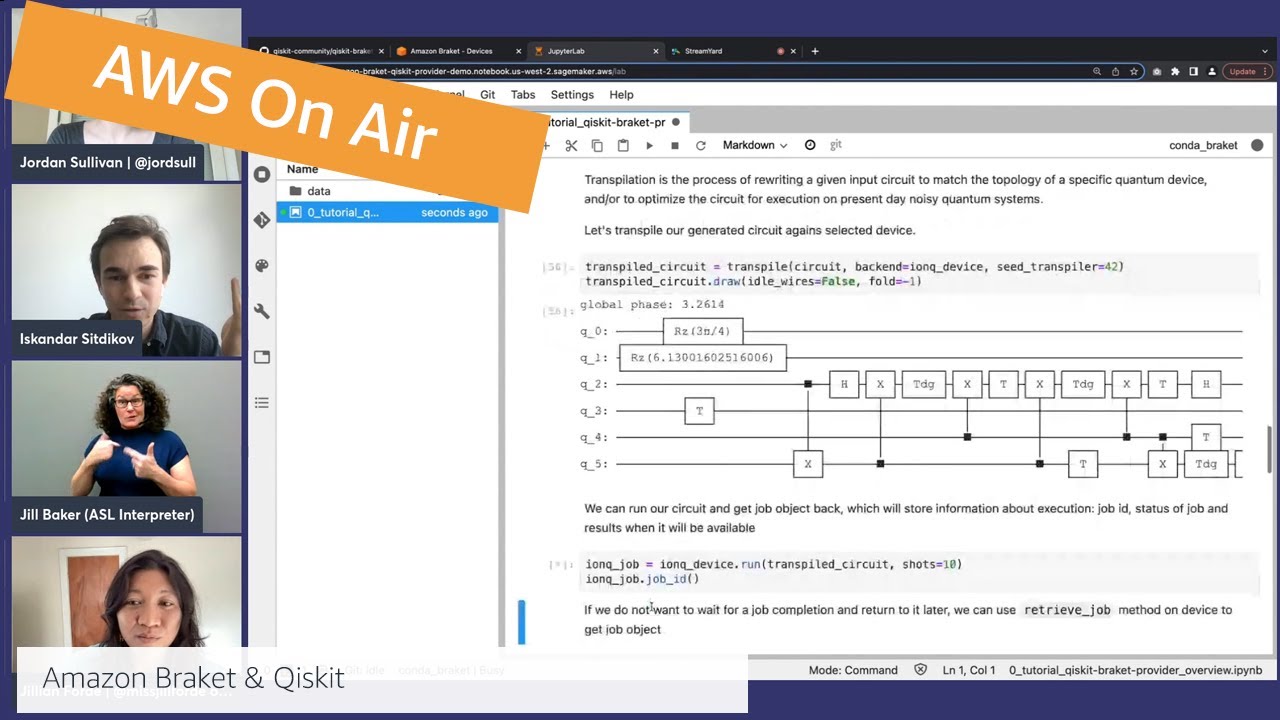
If you’re already deeply embedded in the AWS ecosystem, Amazon Braket feels like a natural extension, offering a managed quantum computing service that provides access to multiple types of quantum hardware from various providers. This “agnostic” approach is a huge differentiator for AI researchers who might want to experiment with different qubit technologies (superconducting, trapped-ion, neutral-atom, photonic) without committing to a single vendor’s stack. Braket seamlessly integrates with other AWS services, making it easy to build complex hybrid classical-quantum workflows using familiar tools like Amazon S3 for data storage or Amazon SageMaker for classical machine learning components.
For AI, Braket’s strength lies in its flexibility and integration capabilities. It supports popular quantum SDKs like PennyLane, which is highly optimized for quantum machine learning tasks and offers tight integration with classical ML frameworks like PyTorch and TensorFlow. This means you can design and train quantum-classical hybrid models directly within a familiar environment. Amazon’s emphasis on managed infrastructure also handles much of the operational overhead, letting AI scientists focus more on algorithm development and less on server management. If you’re looking for an AWS-native, hardware-diverse platform to explore the best quantum computing for AI, Braket is definitely worth your attention.
Braket addresses the content gap regarding hardware diversity and integration with existing cloud infrastructure. Many AI teams are already on AWS, and the ability to spin up quantum resources alongside their classical compute without significant new architectural hurdles is a major advantage. Furthermore, its support for PennyLane means that AI developers can leverage a framework specifically built for quantum differentiable programming, enabling direct exploration of quantum neural networks and variational quantum algorithms. This ease of integration significantly lowers the barrier for conventional AI researchers to begin their quantum journey, making it a powerful contender for practical quantum AI exploration.
Key Benefits for Quantum Computing in AI
- Hardware Agnostic: Access to a diverse range of quantum processing units (QPUs) from different hardware providers (e.g., IonQ, Rigetti, Oxford Quantum Circuits, Pasqal). This allows AI researchers to test algorithms on various qubit technologies.
- AWS Ecosystem Integration: Seamless integration with other Amazon Web Services, including S3, SageMaker, and EC2, enabling the creation of robust hybrid quantum-classical AI workflows.
- Managed Environment: Braket provides managed Jupyter notebooks and development environments, reducing setup time and operational burden for AI developers.
- PennyLane Support: Native support for PennyLane, a leading open-source library for quantum machine learning and quantum differentiable programming, which integrates well with classical ML frameworks.
- Cost Controls: Detailed cost tracking and budget alerts, which are crucial for managing experimental quantum computing expenses in AI research.
Pricing for Amazon Braket for AI
Amazon Braket follows a pay-as-you-go model, charging for simulator usage, task execution on QPUs, and notebook instance uptime. Each hardware provider has its own pricing structure for QPU access, allowing users to select the most cost-effective option for their specific needs. This granular pricing ensures you only pay for what you use, which is ideal for experimental AI work where resource usage can vary significantly.
| Pros | Cons |
|---|---|
| The ability to access multiple types of quantum hardware from a single platform is a significant advantage, allowing for diverse experimentation in quantum AI. Its deep integration with the AWS cloud makes it incredibly convenient for teams already operating within that environment, streamlining data flow and hybrid model deployment. The managed notebooks and PennyLane support are excellent for developer productivity in quantum computing for AI. | While hardware diversity is great, it also means juggling different QPU nuances, which can add complexity. Pricing can become intricate due to the varying rates of different hardware providers. The overall ecosystem, while growing, might not have the same breadth of community-contributed QML examples as Qiskit (yet), though the PennyLane community is very active. Despite its ease of use for AWS users, understanding the underlying quantum mechanics for effective AI algorithm design remains a challenge. |
Discover Amazon Braket for Quantum AI →
3. Microsoft Azure Quantum for AI Solutions

Microsoft’s entry into the quantum race, Azure Quantum, stands out with its focus on developer tooling, particularly its Quantum Development Kit (QDK) and the Q# programming language. For AI practitioners, Q# offers a high-level, domain-specific language designed specifically for quantum algorithm development, which can feel more intuitive than manipulating raw quantum gates for certain applications. Azure Quantum isn’t just about Q#; it also provides access to a range of quantum hardware (IonQ, Quantinuum, Rigetti) and simulators, along with integration into the broader Azure ecosystem.
What makes Azure Quantum particularly interesting for AI is its emphasis on optimization problems, which are a cornerstone of many machine learning algorithms. Their solvers can tackle complex combinatorial optimization tasks that often plague classical AI systems. Beyond that, the platform’s close ties with Azure Machine Learning mean you can build sophisticated hybrid quantum-classical solutions. If you’re an enterprise or a developer already comfortable with the Microsoft development stack and looking for a structured, tool-rich environment to explore the best quantum computing for AI, Azure Quantum provides a compelling proposition.
Azure Quantum directly addresses the “how do I develop quantum algorithms without a physics degree?” content gap with its Q# language. It abstracts away some of the lower-level quantum mechanics, allowing AI developers to focus on the logical flow of their algorithms. Its strong emphasis on quantum optimization is a direct answer to the question “what can quantum computing *actually* do for AI *now*?” as many current AI problems (e.g., feature selection, hyperparameter tuning, resource allocation) are optimization challenges. The integration with Azure ML also ensures that quantum exploration isn’t siloed but can be part of a larger, enterprise-grade AI solution.
Key Benefits for Quantum Computing for AI
- Q# Language & QDK: Microsoft’s proprietary Q# programming language and Quantum Development Kit (QDK) provide a comprehensive set of tools, libraries, and samples specifically for quantum algorithm development, often simplifying complex quantum concepts.
- Quantum Optimization: Strong focus on quantum-inspired optimization solvers that can run on classical hardware, offering immediate practical benefits for AI problems like resource allocation, scheduling, and feature selection.
- Diverse Hardware & Simulators: Access to a variety of quantum hardware providers (IonQ, Quantinuum, Rigetti) and powerful quantum simulators for testing and debugging algorithms.
- Azure Integration: Seamless integration with Azure Machine Learning and other Azure services, facilitating the development of hybrid quantum-classical AI applications within an enterprise cloud environment.
- Learning Resources: Extensive learning paths and documentation through Microsoft Learn, guiding developers from basic quantum concepts to advanced algorithm implementation.
Pricing for Microsoft Azure Quantum for AI
Azure Quantum offers a pay-as-you-go model for QPU usage, similar to other cloud services. It includes a free allowance for a certain amount of QPU time and simulator usage, which is excellent for getting started. Pricing then scales based on the specific hardware provider and resource consumption. Their quantum-inspired optimization solutions, running on classical Azure compute, are priced based on compute time, offering a more predictable cost structure for certain AI tasks.
| Pros | Cons |
|---|---|
| The Q# language and QDK provide a structured, high-level approach to quantum programming, potentially lowering the barrier for entry for many AI developers. Its robust optimization solvers offer immediate value for classical AI problems, blurring the lines between quantum inspiration and quantum execution. Deep integration with Azure services makes it a strong contender for enterprise AI solutions using quantum computing. | While Q# is powerful, it’s a proprietary language, meaning skills learned might not be directly transferable to other quantum platforms. The ecosystem, while growing, is perhaps less community-driven than Qiskit. The “best” quantum computing for AI often depends on the specific problem, and while Azure Quantum excels in optimization, its QML library for general-purpose AI is still evolving compared to some competitors. Getting started still requires a grasp of quantum principles, even with Q#’s abstractions. |
Explore Microsoft Azure Quantum for AI →
How We Conducted Our Research: Beyond the Buzzwords in Quantum AI
Look, the quantum space is notoriously full of buzzwords. “Superposition,” “entanglement,” “quantum supremacy”—it’s enough to make your eyes glaze over faster than a poorly optimized neural network. When we set out to find the best quantum computing for AI, we didn’t just chase the loudest marketing campaigns. We got our hands dirty (figuratively, no actual quantum labs were harmed in the making of this guide) and focused on what truly matters to a smart friend like you.
- Pricing: Evaluating market value and cost efficiency. We looked beyond the “free tier” to understand the true cost of scaling up. Is it genuinely accessible for a startup or an independent researcher, or is it reserved for the Fortune 500 with unlimited R&D budgets? We considered pay-as-you-go models, credit systems, and what you get for your buck when running actual quantum circuits for AI tasks.
- Features: Identifying the “Must-Haves.” It’s not just about raw qubit count. For AI, we prioritized platforms offering strong SDKs (like Qiskit, PennyLane, QDK), dedicated quantum machine learning libraries, robust simulators, and seamless integration with classical AI tools and cloud services. We looked for features that genuinely empower AI developers, not just theoretical physicists. We also considered the ease of building foundational applications for the future.
- Negatives: Transparent debugging of missing features. No platform is perfect. We actively sought out the limitations: long queue times for free hardware, steep learning curves for certain frameworks, or the challenges of debugging complex quantum algorithms. We believe in transparency, so you know exactly what you’re getting into, warts and all. We also considered how these platforms handle complex, cutting-edge concepts like synthetic assets, which might require novel computational approaches.
- Support: Community and refund policy checks. When you’re dealing with a field as complex and nascent as quantum AI, good support is paramount. We evaluated the strength of developer communities, the availability of comprehensive documentation, online courses, and responsive customer service. While refund policies for cloud compute are often standard, knowing you have a reliable resource for troubleshooting can save countless hours of frustration. We also consider the platforms’ commitment to education, because mastering complex subjects like quantum computing or even philosophy requires continuous learning and good guidance. Speaking of learning, if you’re looking to dive deep into new fields and broaden your understanding of these complex technological shifts and their implications, platforms like Audible can be an invaluable resource for listening to expert insights and educational content on the go.
Our goal wasn’t just to list providers, but to give you an honest, grounded assessment so you can make an informed decision about where to invest your time and resources in the pursuit of the best quantum computing for AI.
Conclusion: Picking Your Quantum Playground for AI
So, there you have it. The world of quantum computing for AI is no longer a distant theoretical playground; it’s a rapidly evolving landscape with genuine tools and services that you can start using today. While a full “quantum supremacy” for general AI might still be years away, these QaaS providers are already enabling researchers and developers to explore specific, powerful quantum machine learning algorithms and optimization techniques that can augment or even revolutionize classical AI.
Choosing the “best quantum computing for AI” ultimately comes down to your specific needs, existing tech stack, and learning preferences:
- If you value a robust, open-source ecosystem, a massive community, and a Pythonic workflow, IBM Quantum Experience with Qiskit is probably your best bet. It’s a fantastic entry point for developers already familiar with Python.
- If you’re already deeply embedded in AWS, need access to a variety of quantum hardware architectures, and appreciate managed services with strong QML library support like PennyLane, then Amazon Braket offers unparalleled flexibility.
- And if you prefer a structured development environment, a proprietary quantum language (Q#) that simplifies complex concepts, and a strong focus on quantum-inspired optimization within the Azure ecosystem, then Microsoft Azure Quantum is designed for you.
Each platform offers a free tier or generous credits, making it easier than ever to experiment. My advice? Don’t just read about it; pick one, dive into their tutorials, and start coding. The future of AI will undoubtedly have a quantum flavor, and getting a head start now means you won’t be playing catch-up later when the “quantum AI revolution” isn’t just a buzzword, but a reality. Just try not to break the universe while you’re at it, alright?